
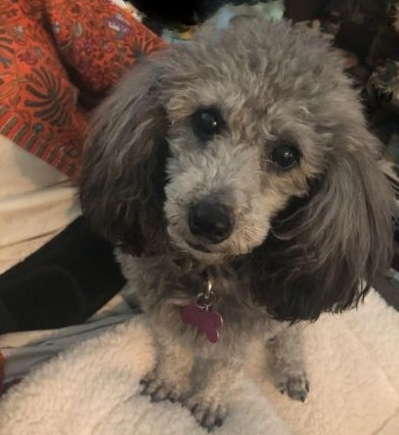
After weeks of paperwork, sending photos and videos of our house, and a video interview, we finally heard the news we were hoping for—we were chosen to foster Ye-Na, a gray poodle with a Daisy collar, rescued from a puppy mill in Korea. The process took about a month, and when we were selected, excitement and anticipation filled our home. We prepared everything for her arrival, from food and toys to making sure the house was a welcoming space for her.
The day Ye-Na arrived was unforgettable. My daughter and I waited at the airport arrivals, nervous but thrilled to welcome her. After what felt like an eternity, we spotted a porter pushing a cart with a dog crate, and there she was—our sweet poodle with her silver-gray fur and big dark eyes. Tears of joy welled up in my eyes. After collecting her paperwork from the flight escort, we carefully loaded Ye-Na into the car, making sure not to open the crate until we were safely home as per the rescue organization’s instructions.
Arriving home, I saw my family waiting with handmade signs saying, “Welcome HOME” and “Welcome Ye-Na.” The warmth of that moment reassured me that fostering Ye-Na was the right decision. We carried the crate into the house and set it down in the living room. After a quiet moment of anticipation, I opened the crate door. Ye-Na cautiously stepped out and, to my amazement, walked directly into my lap, tilting her head up to look at me. In that instant, I knew she wasn’t going to be just a foster dog—she was home. “We can start using her new name,” I announced. “She’s not going anywhere. She’s staying.” Together, we joyfully called out her new name, “Teeeena!”
It’s been six months since that day, and raising Tena has been both challenging and rewarding. Coming from a life of confinement in a puppy mill, Tena didn’t know how to “dog.” She had never lived in a home, let alone navigated stairs or jumped onto a couch. Simple things, like moving up and down steps or getting onto furniture, were foreign to her. She often expected to be picked up and, when lifted, spread her legs awkwardly as though unsure how to be held. It was exhausting at times, but in recent months, there’s been noticeable progress. Tena smiles more now, wags her tail, and even plays. She’s learning to trust and be at ease in her new world.
Looking back, I imagined that bringing Tena into our lives would be a simple, happy ending—a natural conclusion to my journey. But I’ve learned that Tena’s presence isn’t a magical solution to life’s challenges. She is a constant reminder that life is about accepting emotions rather than trying to control them. Living with Parkinson’s has taught me that my emotions are always present, sometimes overwhelming, but I’m learning that the key to managing them isn’t to suppress them but to acknowledge and let them be.
Daisy had given me the advice to just “BE” with Tena, and now I understand what that means. It’s about allowing myself to sit with my feelings without trying to organize or control everything. As a former stage manager, I was trained to rely on plans and schedules, where everything followed a precise call book. But life, as Benny reminded me with a blank document titled “New Call Book,” doesn’t follow a script. He told me, “Your future isn’t written, and you can’t plan what’s next in a constantly changing life.” Annie concluded, “It’s back to Daisy’s advice. You should live the way Tena is discovering how to live. By just being.”
Tena walked up to me, “asking” to be picked up, and then melted into my lap. So, I’ll just sit, then.
 I have Parkinson's. Parkinson's doesn't have me!
Leave a comment