
Who am I, and when did I become this person? Did I lose a younger version of myself to become who I am now? Is the process of transitioning from child to adult like a chrysalis emerging as a beautiful butterfly? It’s a comforting metaphor, but far from realistic. No, we stumble through the teenage years, testing our boundaries and independence. For some, the stumbling continues well into adulthood.
Friends and family who’ve known me for a long time might define me by certain personality traits. But are those traits core or acquired? Perhaps it doesn’t matter to others whether a behavior has been with me since childhood or was adopted later. What matters is how I live my life now. Yet, as I navigate my current feelings, trying to make sense of them, it’s become increasingly important to understand who I am at my core. Who am I aside from the medical diagnoses that seem to overshadow everything these days? The skills and accomplishments of my working life have faded into the background—not just for others, but for me too.
This realization shouldn’t be sad. It was at first—I was angry about losing my ability to work. But recently, as I’ve focused on my health and family, I’ve begun to see myself differently. I’ve started to look back at my childhood, replaying memories like old films in my mind. These flashes of the past reveal traits I hadn’t connected to my adult life, at least not in the past 40 years.
Is this what happens to everyone as they get older? Do we all look back to our childhood to rediscover our core traits? For me, the key years were ages 7 to 11—the age of “innocence.” But there was also a confidence that came with that innocence, a sense of belonging to the world, and an openness to learning from every experience. Life was a discovery, every day a new adventure. I was an observer, taking people as they were, and believing everyone deserves respect.
How did I see my world then, and how do I see it now? Is there a consistent thread? One thing stands out: I was alone a lot as a child—not lonely, just alone. I’ve always been independent, stepping out on my own. I’ve had guidance and learned to ask for help when needed, but I’ve primarily relied on myself. This independence is perhaps my most defining core trait.
Even now, I continue to seek and appreciate help from family and friends, but I don’t live like a hermit crab, hidden in a shell. I’m content with the life I’ve led and with the child who was confident in her aloneness.
Hunter S. Thompson once wrote, “We are all alone, born alone, die alone, and—in spite of True Romance magazines—we shall all someday look back on our lives and see that, in spite of our company, we were alone the whole way. I do not say lonely—at least, not all the time—but essentially, and finally, alone. This is what makes your self-respect so important, and I don’t see how you can respect yourself if you must look in the hearts and minds of others for your happiness.”
Thompson’s words resonate deeply with me. They underscore the importance of self-respect, which, for me, is rooted in the understanding and acceptance of who I am—alone but not lonely, independent yet connected, and always striving to honor the core traits that have shaped my life.
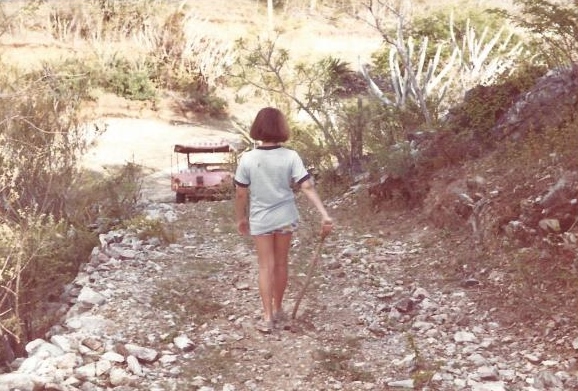
About the photo
Virgin Gorda, BVI, Summer 1974, Age 11
This is my favorite photo of myself. It shows my independence, my confidence and my connection to my surroundings. Plus I’m wearing my favorite shorts at the time. The photo brings vivid memories back of a daily routine established when we lived in a small house atop Mahoe Bay. The rocky road in the photo continues behind camera and down into a very large and dense area of vegetation by the beach. The house is to the left. That’s the pink and rusty mini-moke at the end of the driveway. I learned to drive in this car. Right hand drive, too. At the foot of the house’s front deck and entrance is a flimsy barbed-wire and wood stick gate that stretches across the road. Across the road there is a very narrow footpath that leads down to the beach. The goats in the area would work their way down that narrow foot path in the evening so they could feast on the vegetation below. They would stay down there for a couple of days usually. But rather than walk back up the narrow foot path, they would come up the road. This meant that they got stuck when they reached the top and the fence across the road. On those early mornings the goats bleating for help would wake me up. So I would raise and twist the loose wire gate and prop it up, with the stick I am holding in the photo, so the goats could get through. And of course, they would return in a day or two so we could do that routine all over again.


Leave a Reply